The second training day of ECO-ENTREPRENEUR focused on one of the most important topics of the project: how to turn sustainability into practical action.
After the group-building process of the first day, participants were ready to explore circular economy, sustainable business models and practical tools that can be used with young people in local communities.
The day started with a short recap. Participants shared what they had learned during the first sessions and connected those ideas with their own work as youth workers. This helped reinforce the learning process and created continuity between the different parts of the training.
One of the strongest activities of the morning was the Sustainability Reality Check. Each national team presented environmental challenges from its own country or local context. The topics included waste management, overconsumption, lack of green jobs, limited sustainability education and the need for stronger youth participation in environmental action.
This session was valuable because it connected local realities with European challenges. Participants could see that sustainability is not an abstract topic. It affects communities, employment, education and the future of young people.
The next step was an introduction to the circular economy. Participants explored how circular models differ from the traditional linear model of production and consumption. Instead of “take, make and waste”, circular economy promotes reuse, repair, reduction, recycling and smarter resource management.
To make the topic more practical, the group analysed real examples of sustainable businesses, including Ecoalf and Too Good To Go. These examples helped participants understand how environmental values can become part of a viable business model.
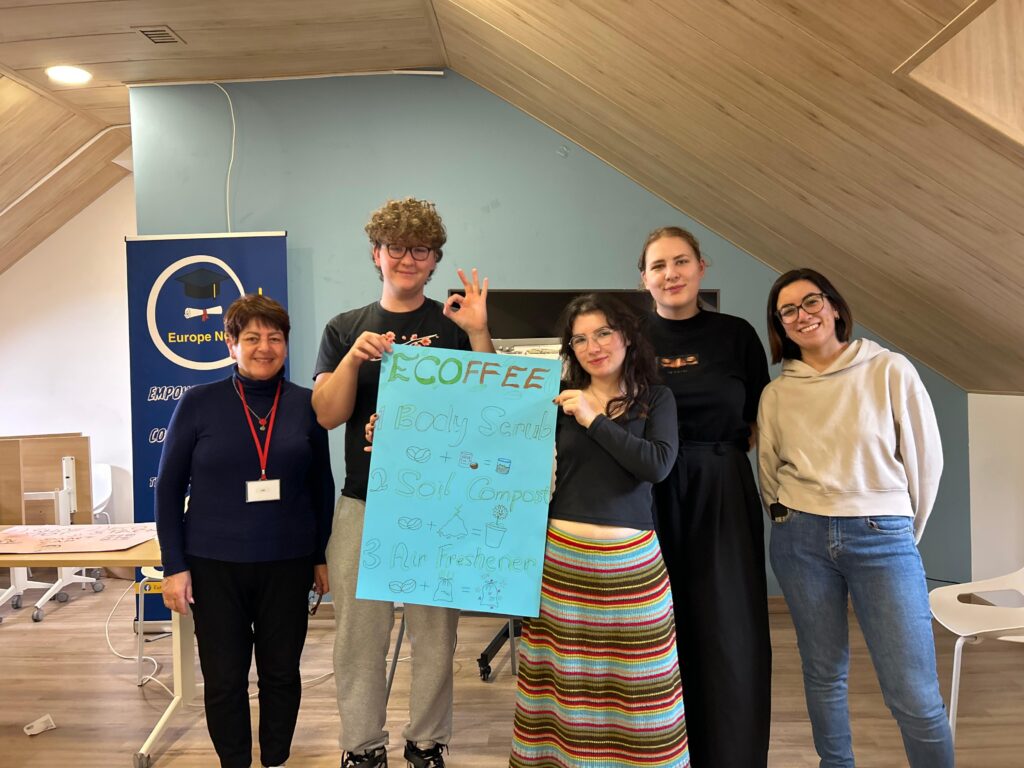
In the afternoon, participants took part in the Zero-Waste Challenge. Working in international teams, they designed creative solutions to reduce waste in everyday situations. This activity combined innovation, cooperation and problem-solving.
The group also worked with the Eco-Business Model Canvas, a tool that helps structure green business ideas. Participants reflected on value proposition, target groups, environmental impact, key resources, partners and long-term sustainability.
The day also included a session on green mentoring. Participants explored how youth workers can support young people who want to develop sustainable ideas but may lack confidence, resources or knowledge.
A powerful part of the discussion focused on the value of mistakes. Participants reflected on failure as a normal part of learning and entrepreneurship. This helped strengthen a growth mindset and a more realistic approach to supporting young people.
By the end of Day 2, participants had not only learned about circular economy. They had tested practical methods, analysed real examples and gained tools they can adapt in their own youth work.